
Land Banking vs. Rental Income: Which Strategy Wins in 2026?


The Nigerian real estate market has entered a “Recalibration Cycle” in 2026. With the Naira stabilizing around ₦1,100 – ₦1,200/$ and inflation finally cooling to the mid-teens, investors are asking a critical question: Should I lock my capital in land or chase monthly rent?
Both strategies have served Nigerians well as inflation hedges, but 2026 presents unique winners and losers. Here is the breakdown of which strategy wins for your specific goals.
1. Land Banking: The High-Growth “Patient” Play
Land banking remains the king of capital appreciation in Nigeria, especially as urban boundaries expand toward the “New Lagos” and “Outer Abuja.”
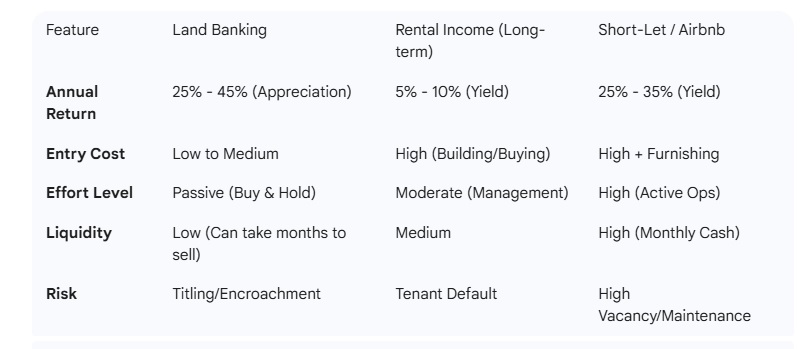
– 2026 Performance: Emerging corridors like Epe and Ibeju-Lekki are seeing annual appreciation rates of 25% – 35%.
– Best Locations: * Lagos: Epe (due to the Food Logistics Hub), Ikorodu (spillover from the 4th Mainland Bridge construction), and the Lekki-Epe corridor. Abuja: Karsana, Kuje, and Kurudu Extension.
Who Wins? The “Wealth Builder.” If you don’t need immediate cash flow and want to double your money in 3–5 years, land banking is your winner.
SEO Tip: Search for “C of O verified land” to ensure your land banking investment is secure from government acquisitions or “Omonile” issues.
2. Rental Income: The Cash Flow Champion
In 2026, the rental market is shifting from “defensive” (raising rents to survive inflation) to “yield management.” With a housing deficit of over 28 million units, the demand for compact, serviced apartments is at an all-time high.
– The Yield Reality: * Standard Rentals: Average gross yields are hovering around 7.5% – 10% in middle-market areas like Yaba, Surulere, and Gwarinpa.
– Short-Lets: High-end serviced apartments in Lekki Phase 1, Victoria Island, and Maitama are delivering staggering yields of 25% – 35% due to the rebound in corporate travel and diaspora visits.
The Winner: The “Income Seeker.” If you want your investment to pay your bills today, rental income—specifically the Short-Let model—is the winner.
At a Glance: Comparison Table 2026
3. The 2026 “X-Factor”: Infrastructure-Led Growth
In 2026, the biggest winner isn’t just a strategy, but a location. Properties along the Lagos-Calabar Coastal Highway and the Abuja Light Rail routes are seeing “double-dipping” returns—high rental demand and massive land appreciation.
Why Rental Income is catching up:
For the first time in years, the “Replacement Cost” of buildings is stabilizing. Landlords are no longer hiking rents by 50% just to keep up with the cost of cement; they are focusing on tenant retention and renewable energy (Solar) to lower overhead costs and increase net profit.
The Verdict: Which Wins for You?
Choose Land Banking if: You are under 40, building a retirement nest egg, or have limited capital (₦5M – ₦15M range). Focus on Epe or Karsana (Abuja).
Choose Rental Income if: You have significant capital (₦80M+) and need monthly or annual cash flow to hedge against the cost of living. Focus on compact 1-2 bedroom apartments in high-density urban hubs.
Final Thoughts
In 2026, the “Hybrid” strategy is the ultimate winner. Smart investors are using 70% of their capital for land banking in high-growth corridors while using the remaining 30% to buy off-plan apartments for future rental income.

